 |
| M13 Hercules Globular Cluster VAO, Webster NY FWHM 2.2", 1x1 bin, 0.54 "/pix 12" Meade SCT © Billy Vazquez |
Monday, July 30, 2012
M13 - Hercules Globular Cluster


Tuesday, February 14, 2012
Opposition of Eros

Eros is an asteroid in a high elliptical orbit around the Sun. It was discovered in 1878 and it is 33 km wide.
Back in the late 1920's, astronomers around the world knew that Eros will be again close to the Earth in 1931. They made calculations of the star field where Eros will transit to attempt to calculate the distance to Eros. This was a large undertaking as precise measurements of the stars needed to be done as well as of Eros.
Simultaneous observations of Eros from different parts of the world provides the necessary data to calculate distances using parallax.
Three weeks ago, Eros was in opposition again at a distance of 0.2 AU from Earth. Astronomers around the world are attempting a re-enactment of the observations and calculations done back in 1931. Not only will we be able to determine the distance to Eros, but we could estimate with these measurements the size of our Solar system. The animated image was captured from VAO in Webster, NY and shows (roughly), Eros transiting at a speed on the plane of the sky of 7 arc seconds per minute.
Saturday, December 3, 2011
Photometry for Astronomers

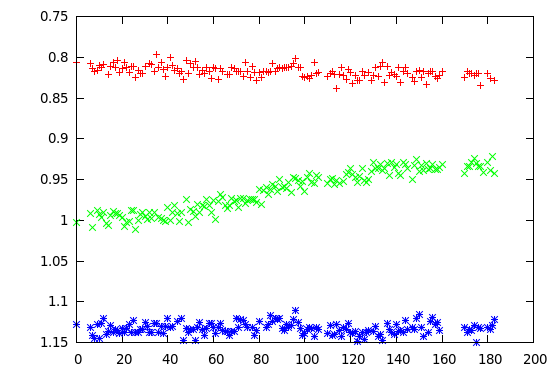 |
| Photometric results of VAO Observations on 11/21/2011 |
Astronomers interested in the variability of stars need a tool to understand how they vary in time. This tool is called photometry and it is widely used by astronomers to study not only intrinsic star variability but the more familiar exoplanet transit searches. It is also used to study galaxies and other extended objects. So why study changes in "brightness"?
Changes in brightness can lead to the discovery of eclipsing binaries, transiting exoplanets, exotrojans and exomoons. It can tell you about the morphology of Active Galactic Nuclei and about the properties of supernovae explosions. You can infer from the data when you collect it over time about the physical properties of the object you are studying.
The plots to the right are examples of light curves or in other words many measurements of the intensity of stars over a period of time. On the horizontal axis you have number of exposures. On this particular case each tick on the axis is roughly 80 seconds. On the vertical we have the instrumental magnitude of the star. As you can tell by the graphs there are stars on this ensemble that vary on time scales of hours. These measurements were taken on VAO in Webster NY and the graphs are the results of the photometric pipeline I setup for this particular field.
Monday, November 7, 2011
The WIYN 0.9m Observatory @ Kitt Peak
 |
| Kitt Peak National Observatory |
Today there are no pretty pictures of the wonders of the Universe from the VAO observatory in Webster, NY. Instead, I bring you images of where I will be for the next week, Kitt Peak National Observatory. Located 56 miles from Tucson, Arizona at an elevation of 6,875 feet above sea level. KPNO has the largest collection of telescopes in the world. 24 optical telescopes and 2 radio observatories.
So why KPNO?
 |
| On the left, the WIYN 0.9 m Observatory |
KPNO houses the WIYN consortium 0.9 meter telescope of which Rochester Institute of Technology is a partner among other educational institutions. As part of the partnership, faculty and students of RIT have the opportunity to conduct research and educational projects.
Why is this important to me, you say? Well to begin, the night sky at KPNO is one of the best in the nation and the opportunity to image with a telescope that is 3 times the aperture size of the one I have is compelling. Not to mention this will advance 2 of the projects I am currently working on. The first project is on AGN (Active Galactic Nuclei), galaxies where their central super massive blackhole is accreating mass. The second project is on the characterization of transiting exoplanets and their apsidal precession due to the effects predicted by Albert Einstein's theory of General Relativity.
Stay tuned for the results of this trip!
Stay tuned for the results of this trip!
Thursday, November 3, 2011
M78, McNeil's Nebula, v1647Ori what do these things have in common?
 |
| M78, McNeil's Nebula and v1647Ori ©Billy Vazquez, 2011 @ VAO Webster, NY |
They are all part of the Orion Molecular Cloud Complex. They are also part of these image taken from VAO a few nights ago. M78 on the upper left corner of these image is an HII region and it the brightest and most prominent object of this field but regardless there are several other nebula like objects, for example McNeil's Nebula.
McNeil's Nebula has a very interesting story behind it. Discovered by McNeil in 2003 after having done an exhaustive search on this field at different epochs. But was it really a new object in the sky? Apparently as close to the mid 1960s and by no other than an amateur astronomer(Evered Kramer). There is clear evidence that the nebula was visible then. So how come it disappeared just to reappear again for McNeil to find? This is still the topic of active research. The prevalent explanation is that the young star v1647Ori has episodic outburst whose light reflects and scatters by the dust in McNeil's Nebula.
These outbursts from young stars and their associated nebulosity are coined Herbig-Haro objects and they are like I said still the subject of astronomical research, so that we can understand the physics that powers this phenomena.
Saturday, October 29, 2011
M103
 |
| M103 from VAO, Webster, NY © Billy Vazquez 2011 |
A young open cluster in the constellation Cassiopeia. But how young is young, that is the question? The age of this open cluster was estimated to be around 16 million years at a distance of 2900 parsec (Sanner et al., 1999). The Solar System is roughly 4.5 billion years old. If we use the age of our solar system and compare it to the stars in this cluster we come to the conclusion that the cluster is younger by 3 orders of magnitude.
 |
| M103 from VAO, Webster, NY © Billy Vazquez 2011 |
The images of M103 shown were taken using a Johnson V band filter with VAO's 12" SCT @ f/6.3. They are 36x60 sec exposures co-added in Maxim DL for a total exposure time of 36 minutes. The imgages were dark and flat subtracted but no further image processing performed other than the color inversion of the second image.
Tuesday, October 11, 2011
Horsehead Nebula

The Horsehead Nebula also known as Barnard 33 is a dark nebula in the constellation Orion and it is located just south of Alnitak. This dark nebula is located about 1500 light years away from Earth. The red glow is imparted by ionized hydrogen from nearby star Sigma Orionis.
The image shown was taken at VAO with broadband Johnson BVR filters. Total exposure time is 55 minutes ( 4x300s on B and V, 3x300s on R filters). It was further processed in PixInsight for dark subtraction and flat field division. A median noise reduction algorithm was used with a 3x3 kernel to eliminate most of the chrominance noise. The telescope used was the 12" inch SCT at f/6.3. Guiding was done with Metaguide with an 80mm APO refractor and Lumenera Skynix.

In addition I present to you the unedited out of the telescope combined image of 55 minutes on a single grey channel. You can see the vignetting of the smaller filters over the larger CCD chip area. As you would imagine this nebula would look much better over narrowband filters to expose more of the filamentary structure at the edges of the dark nebula.
Subscribe to:
Posts (Atom)