Tuesday, June 7, 2011

M24 and Collimation Gone Wrong

M24, Orion Parsec 8300M, 4x10 sec, f/6.3, fl 3048,
12" aperture, luminance filter, 1x1 bin, no auto guide,
no AO, 6/5/2011 1:08 AM EST, Webster, NY
© Billy Vazquez VAO(Vazquez Astronomical Observatory)
Messier 24 is not really a stellar object but a bunch of stars along the spiral arms of the Milky Way that happen to be all bunched up along the line of sight nicely without stuff to block the light coming from them (aka. extinction).  Last night I chose this nice field of stars to test how bad the collimation of my Meade LX200 12" telescope is. And boy is it bad!  
First, you might ask, what is collimation? Well if you click the link you can get all the cool details about it, but in a nutshell it is the proper alignment of all the optics in a telescope.  How do I know my telescope is not correctly collimated?  Well click on the image to the right and see for yourself.  The stars are supposed to be nice round dots.  Instead, M24 stars look like bloated egg shaped, non uniform blobs of light!   That is just not right!

So you may ask, what can I do about it?  I need to collimate (align) the optics of my telescope.  For SCT's there are typically  3 screws in the center of the corrector plate that holds the secondary mirror in place.  These screws need to be adjusted to obtain a nice round star shape when in focus.  So what causes the misalignment?  Vibrations, bumping against the telescope, transporting the telescope, basically any movement of the telescope eventually can throw off the alignment.  Stay tuned to the blog and I will bring you the results of my collimation and hopefully a better image of M24, with more information about how I will fix this issue.

Saturday, June 4, 2011

Vignetting, Tracking, SNR, PEC, Polar Alignment and M15?

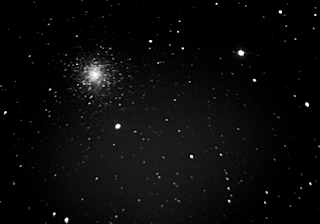
M15, f/6.3, 1x1 bin, 300mm aperture, 3048 focal length
4x20 sec exposure, Orion Parsec 8300M, 0.9"/pix plate scale
Webster, NY, 6/3/2011 4:00 AM EST, © Billy Vazquez
There is much to learn about operating a telescope for scientific purposes or astrophotography than your typical night under the stars for casual observing. To the right, you see an image taken from VAO (Vazquez Astronomical Observatory) in Webster, NY  on 6/3/2011 at 4:00 AM in the morning.  I used a Meade LX200 12" telescope and Orion Parsec 8300M camera through a luminance filter.  I used MaximDL as the imaging software, binned at 1x1, 4x20 sec exposures, dark substracted, no flats, no auto-guiding.  The images are the raw images stacked, registered and dark substracted with CCDStack. I used GIMP to modify the contrast and brightness of the resulting stacked image.

So what is so special about this image?  Well lots of things!  Lets enumerate some of the things I will talk about on this blog: Polar Alignment, Periodic Error Correction (PEC), Tracking, Signal To Noise Ratio and Vignetting.

First, in order to do accurate and precise imaging a telescope needs to be polar aligned.  You might have heard that this is as simple as to point your telescope at Polaris (North Star) while your telescope is at the polar position.  This is good enough for casual observing as it will give any GOTO mount the ability to point roughly to the area of the sky where your object of interest is.  Unfortunately, Polaris is not exactly at the celestial north pole.  What this means is that for imaging, you need to have your telescope precisely polar aligned.  There are many methods to do this, the most popular is the drift polar align method and the Kochab Clock Method.   I used the drift method, assisted by Pempro Polar Aligned Wizard.   This is by far, the most time/effort consuming task I have ever done for any astronomical endeavor.

Next, Periodic Error Correction (PEC), all mounts are imperfect mechanical machines.  Therefore, there are (in addition to drift from non-precise polar alignment) 2 sources of error while tracking a target.  The first is RA periodic error, or the error of tracking in right ascencion.   This error can be minimized (but never eliminated) by using PEC if your mount provides such a service.  I used Pempro to program my mount to reduce this error.   This is easier to do than polar alignment because of Pempro, but still requires considerable amount of time and patience.  For example, I have reduced my mount RA error from 75 arcsec to 25 arcsec and it took me over 7 hours to do this.   I still need to refine this error to bring it down to the single digits.  Next, DEC periodic error,  this one cannot be eliminated with Pempro.  It is mostly due to 2 things, imprecise polar alignment and mechanical fluctuations like dynamical flexure.  How do I deal with this?  Well I have not yet and it clearly shows in the image.   The image was taking without auto guiding, to see how good or bad the raw tracking of the mount is.  Auto-Guiding and Adaptive Optics should help reduce the error on the declination axis.

Tracking, most GOTO mounts provide Sidereal Tracking, a fancy phrase for tracking stars as they  move across the sky.   The tracking of the raw mount is affected by many things, balance, mechanical imperfections of the gears, flexure and polar alignment to mention a few.  The image above is an unguided exposure.   This means that only the mount was trying to keep up with the movement of the stars across the sky over 20 seconds.  That is why you see star trails and stars that look like ellipses instead of perfect circles.   I was expecting this result, which is why I took the images in the first place.  Considering the quality of the mount, the amount of RA error I still have and the exposure time of 20 seconds this is better than expected.

Signal to Noise ratio, is the ratio of the amount of light from celestial objects in your image vs. the amount of unwanted signal due to electronics of your CCD detector and other noise sources.   I want to increase that ratio and the easiest way to do it is to add up images of the same object.  For my image, I took 4 images of the same duration, 20 seconds.  Then add them up.   This should have incerased the SNR by approximately a factor of 2.  The more images you stack the better your SNR is until you hit diminishing returns.

A great feature of this image is what we call Vignetting.   Vignetting is caused by reducing the amount of light received by the CCD detector along the optical path.   Basically, it is a shadow.  You can see that the center of the image is brighter than the edges.  How should I deal with this?   Easy,  taking flat exposures.   Flats are images taken against an uniform light background.  These images are stacked, combined and dark reduced to create an image that shows the lighting imperfections of the optics in your telescope setup.  I did not do it for this image to see the effect. 

And last M15.  Why did I choose M15?  Well the honest truth is that it was 4:00 AM in the morning after a long night of trying to correct PEC and I wanted to see how good my polar alignment was, so I decided to do a few slews (moving the telescope from one point to another) to check my pointing accuracy.  M15 was about 50 degrees East of my last position on the PEC run so I said... "Hey why not?"   One slew later... I took a 5 second exposure and... BAM!  M15 was right there.  Not centered by any means, which means I will need to use TPoint at some point to start correcting the pointing precision. But nonetheless, within 14 arcmin from the center of my field of view.

Monday, May 30, 2011

Pluto a planet's discovery story

Courtesy of Astro Leo's planets
Pluto's discovery story is not only an important part of Astronomy's history, it is also part of American history. It all started with Uranus, the 7th planet. In the early 1840's French mathematician Urbain Le Verrier predicted that there should be another celestial body perturbing the orbit of planet Uranus. The story of the discovery of Neptune then confirmed this prediction from Le Verrier. Further observations of Uranus later in the 19th century led to the speculation of yet another celestial body still perturbing Uranus.  Therefore in 1906, Percival Lowell from Boston Massachusetts, started a project in search for the 9th planet from the Lowell Observatory in Flagstaff, Arizona.  Lowell died without knowing that the observatory had imaged Pluto but had failed to recognize it.

The search for Pluto was put into hiatus until 1929, when Clyde Tombaugh a natural from Kansas, working at the Lowell Observatory finally found a moving object in photographic plates between the nights of Januray 23rd and Janurary 29th, 1930.  The results were sent to the Harvard Observatory on March 13, 1930 after confirming with a third exposure made before in January 21st.  The name's that went up for vote were Minerva, Cronus and Pluto.   Pluto received every vote!


Wednesday, May 25, 2011

The Expanded Very Large Array


EVLA image of supernova G55.7+3.4
Bhatmagar et al.
The electromagnetic spectrum is the realm of astronomers. From high energetic X-Ray photons to the the long wavelength radio photons. So how do we detect these radio photons? The answer is: radio telescopes. Why are they called telescopes anyways? Well, they let us "see" into the universe at frequencies where our eyes can't see. But more impressive, we can take pictures of the night sky so that we can see what our eyes couldn't otherwise. Radio telescopes have been around for a long time now. The largest single dish Radio telescope in the world is in Arecibo, Puerto Rico. If you have ever seen the movie "Contact", then you have seen this excellent facility. Another entertaining sci-fi movie is "The Arrival". On this movie we see a telescope facility of 27 white dishes. These dishes are the famous Very Large Array telescope in New Mexico.

The Very Large Array has recently been beefed up and renamed the EVLA or Expanded Very Large Array.  The image above is supernova G55.7+3.4, the remnant of a star that blew up to smithereens. The filamentation seen on this radio image was not visible until the EVLA was upgraded to be 10 times more sensitive that in the past.   So what was changed in VLA?  Well it was pretty much gutted out of the 1970's electronics and added new 2000 tech to it.   This new and improved electronics makes the VLA so much more sensitive than before.  So why the image of a supernova remnant?  Can't we already see these objects in the sky?   Sure we can!  But not like this.   Imagine that you are watching your favorite movie on your old TV without high definition.   Now erase that memory and imagine your favorite movie in HD (high definition).   The difference is like night and day!  That is a good analogy to the new revamped EVLA.  We will be able to see fainter and deeper into our galaxy and detect until now unseen objects and reveal new details on existing ones.

Tuesday, May 17, 2011

SETI goes Kepler

Courtesy of NASA/Ames Research Center
The search for extraterrestrial intelligence (SETI) is one of the outstanding questions on the minds of many.   Needless, to say, this stems from a need to know if we are alone in the Universe.  SETI is focusing its search on the recent data release from the Kepler Space Telescope.   SETI has selected 86 planets from the the 1235 released by Kepler.   Why only 86?  Well, the main reason for this is that they want planets that can sustain water in liquid form.  Many of the planets detected by Kepler, so far, are giant gaseous roasters.

The search will be performed with the Green Bank Radio Telescope in West Virginia.   This facility can  record over 60 terabytes of data per day of observations in the range between the 21 cm hydrogen line and the 18 cm hydroxyl line.  Why between these 2 lines?  Well, to begin with this region on the radio is rather quite in the Universe and it is not absorbed by anything that we know of.  And second, SETI scientists believe that an intelligent civilization that depends on water will broadcast signals in this region dubbed, the "water hole" region.

The question remains, will we find intelligent life via radio waves?   Well, the answer is really out there, according with extrapolations from the Kepler observations, we could easily find about 50 billion planets in the Milky Way.  That is a huge number of planets.  Perhaps ET is in one of them!

Wednesday, May 11, 2011

Stars Delivered in 10 seconds a lesson in Magnitude

Welcome back to another astronomy blog after a long week.   On the right there is an image of the sky taken with my SCT 12" telescope and my main CCD camera. The exposure was 10 seconds long in the neighborhood of the North Star, Polaris.   The first feature I would like to point out on this image is the light bleeding out from Polaris into the image.   Even though Polaris itself is not on the image you can still see the light streaking out from the left side of the image.  This is because Polaris has an apparent magnitude of 1.97.  That means that it is a very bright star. For comparison, a full Moon has an apparent magnitude of -12.7.   The more negative the magnitude the brighter the object is.

The image is also inverted in color space.  What this means is that the black dots are the stars.  It is sometimes easier to see them this way.  Now lets talk about the stars on the image.  The brightest of them is the one that look the largest on the image, slightly right off center.  This is HR 286 a 6.47 apparent magnitude main sequence star.  Now, try this out, find the dimmest star on the image.  There are several very dim stars on this image.   Their apparent magnitude is around 14.

But what does this apparent magnitude means?  It means that a star of 0 magnitude is 100 times brighter than a star of 6th magnitude.   In our previous example HR 286 is approximately 1000 times brighter than the dimmest star in the image.   That is a LOT brighter!

Wednesday, May 4, 2011

M15 a Globular Cluster in our Milky Way


Messier 15 is a globular cluster in our Galaxy, that is to say, it is a bunch of stars that are bound gravitationally and travel along our Milky Way galaxy as a set.   Globular Clusters are different than Open Clusters by the fact that there could be hundred of thousands of stars in them commpared to the tens you find in Open Clusters. So you may ask yourself the following question: Is a Globular Cluster a Mini Galaxy in of itself?   This is a very good question, that has many answers depending on who you ask.   That wasn't very helpful.  Was it?    Well here is one of the defining criteria according to me!   A Globular Cluster is not a Galaxy because there is no current material exchange in the evolution process of their stars.  In English, what that means is that GCs are typically gas less objects.   There is little to no gas in them which inhibits their star formation.  Galaxies in general have gas and star formation process.

So why M15 for today's blog?   Well, other than it is a very pretty and super dense cluster in our Milky Way, it is believed that among its numerous star in its core there is a black hole.  It is also a magnitude 6.2 object in the sky, which means that it is a the limit of naked eye visibility under exceptionally good conditions and easily found with binoculars.   It is also the home of PSR 2127+11 C , a pulsar that is on a binary system with another neutron star.   This binary system is test ground for the theory of General Relativity and gravitational waves. Also, Pease 1 is the first planetary nebula found on a Globular Cluster.   It is home to 119 variable stars.  Its age has been calculated to be around 13.2 billion years old?  Isn't that mind boggling?

So in general M15 is a sandbox of astronomical science.  It has a bit for everyone from observational to theoretical astrophysicists.